Designing for Inclusion.
07 February 2022 (Kuwait City) - The AWAKEN Youth Fellowship open house invited the community to explore and reflect on the key themes of the program through a set of creative and interactive experiences and activities offered in the space, held in collaboration with our community partners. This included: Two self reflection and storytelling workshops led by Baladkum co-founder; Zeinab Wasfy and Warshagraph Artist; Ahmed Soliman, live art and data visualization by Sandigan team member and artist; Ben Braga, and a live jam session by Talal Jasmi, Noiak Bedirian, Ali Khajah, and Azzam ElHassan. The event also featured a collection of installations put together by the participants of the program, each offering an insight and perspective into the themes, exercises and conversations which deeply resonated with them in their personal experience(s) of the twelve weeks we spent together. This featured:
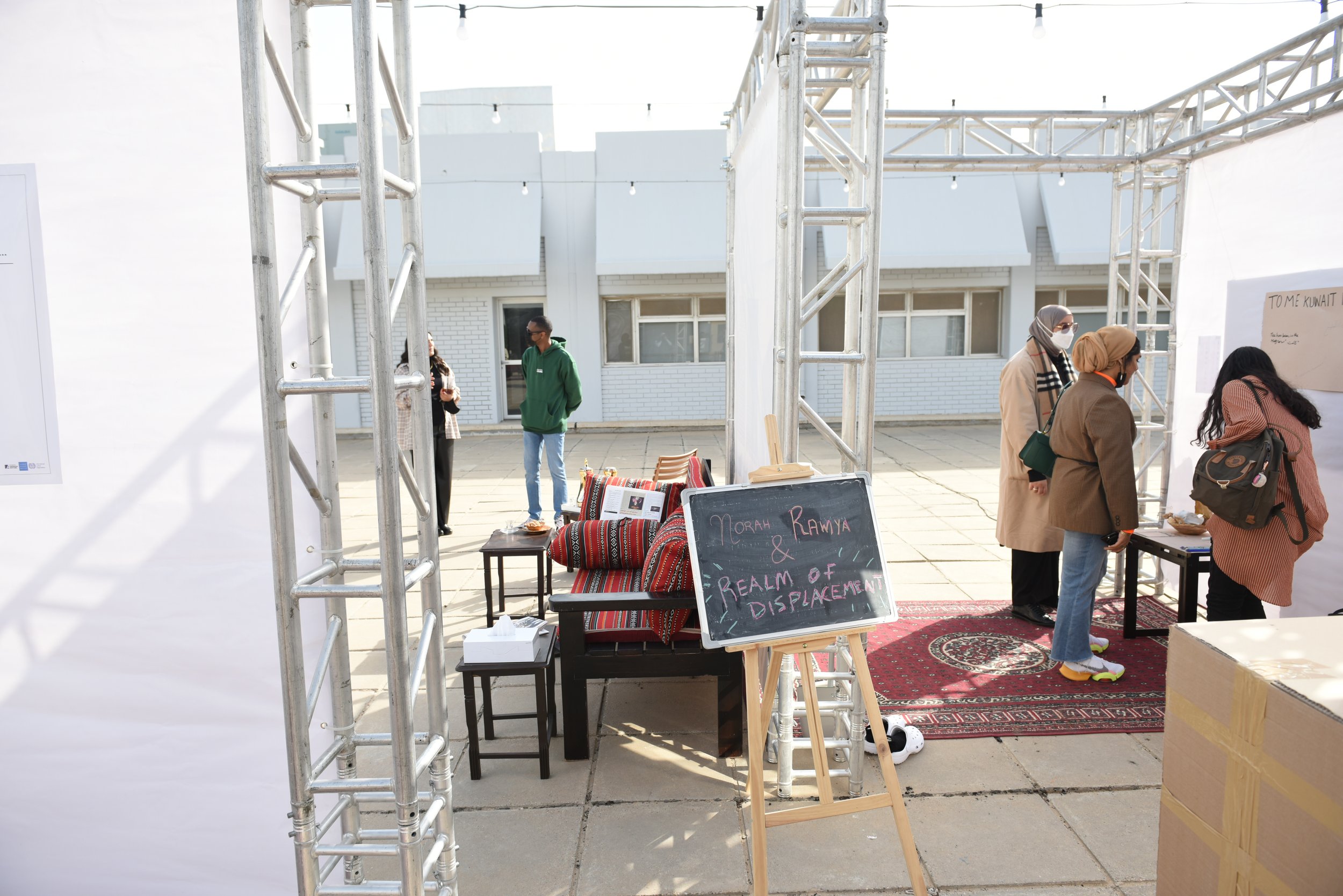
‘Realms of Displacement,’ by Rawiya AlAwadi and Norah Altararwah
Norah and Rawiya were interested in deconstructing the production of meaning and identity in Kuwait, as experienced both spatially and culturally. Their installation showed a juxtaposition between two gendered spaces commonly encountered in a private Kuwaiti home and/or public space: the Diwaniya; an exclusively male, political space and the ‘sala’ or living room, which is seen by some as the ‘female equivalent,’ gathering women daily within each family and neighborhood for ‘chai dhuha’ or afternoon tea.
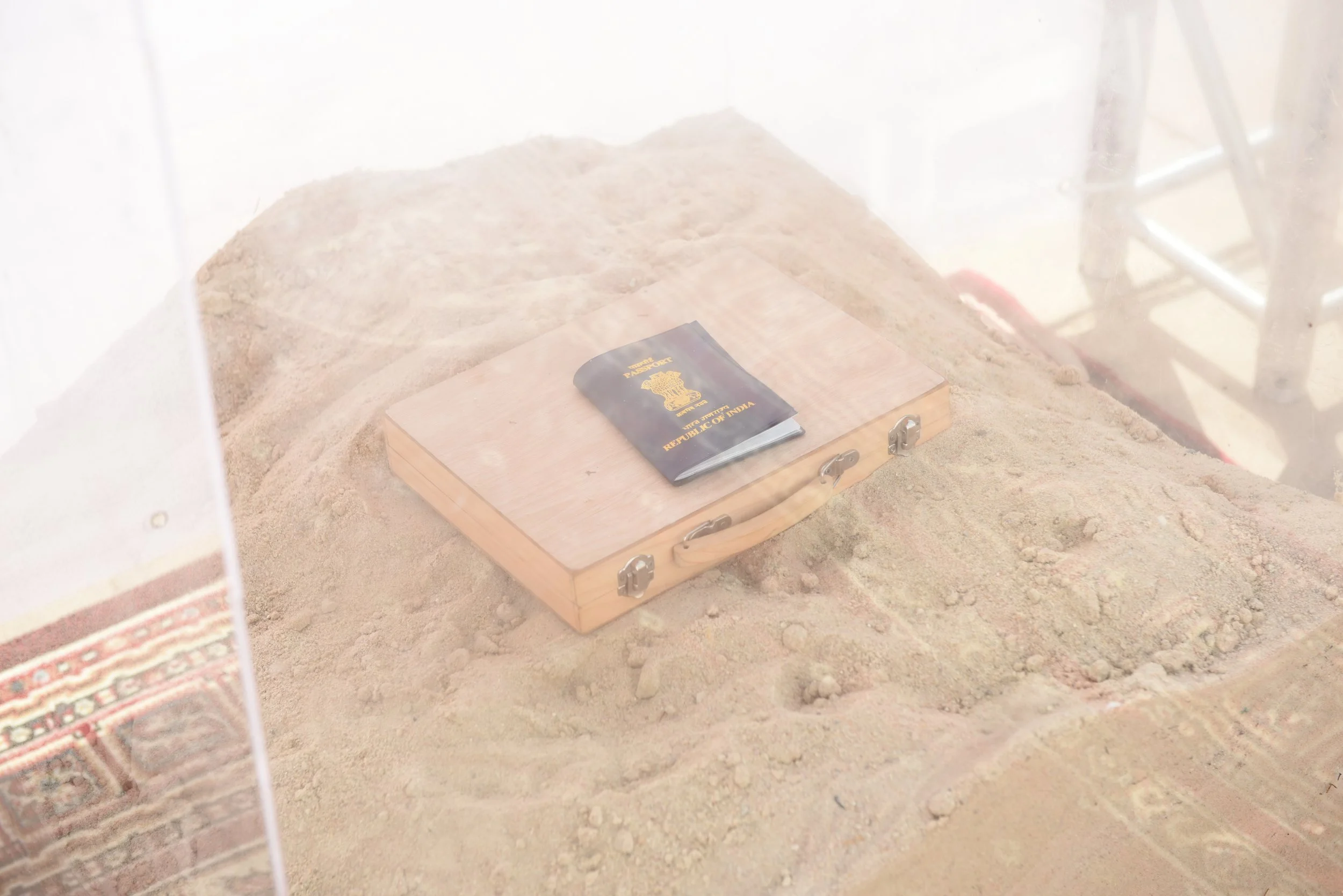
‘Raeth,’ by Taiba Pattan
Raeth, by Taiba, featured a very simple and evocative visual and felt experience. Her piece presented a large, transparent acrylic box filled with a mountain of sand, with a singular travel case and Indian passport placed on top. She intended, with her installation, to capture the ephemeral and transient nature, experience and value of migrant workers and expatriates in Kuwait. Taiba aspires to tell the story of the countless lives, including her own, which are experienced as momentary as the sand that slips through your fingers; “of perpetual transience”.

‘Uncover,’ by Taibah AlMasoud and Lulwa Ali AlMufarrej
Taibah and Lulwa paid homage - with their piece - to the subjectivity of thought and experience, and the lack of existence of absolute truth, particularly as it relates to both equity and privilege. With their interactive maze, which they built using cardboard and mirror, they invited attendees to question their truths around their own privileges, through a set of simple and thought-provoking games and reflection prompts, leaving notes and instructions for people to interact with.

‘Awaken: On Emotions & Empathy,’ by Rawan Yousef Manhi and Deema Al Wugayan
Deema and Rawan produced an interactive poster and a video, to provoke a sense of empathy in attendees around the experiences of migrant and specifically domestic workers. Through a series of small exercises, they encouraged people to start to connect more deeply to their emotions, and to embody how they feel as they reflect on concepts of safety, space and access. Realizing that as we move through our environments, our representation of space becomes intertwined with our emotional experience.”
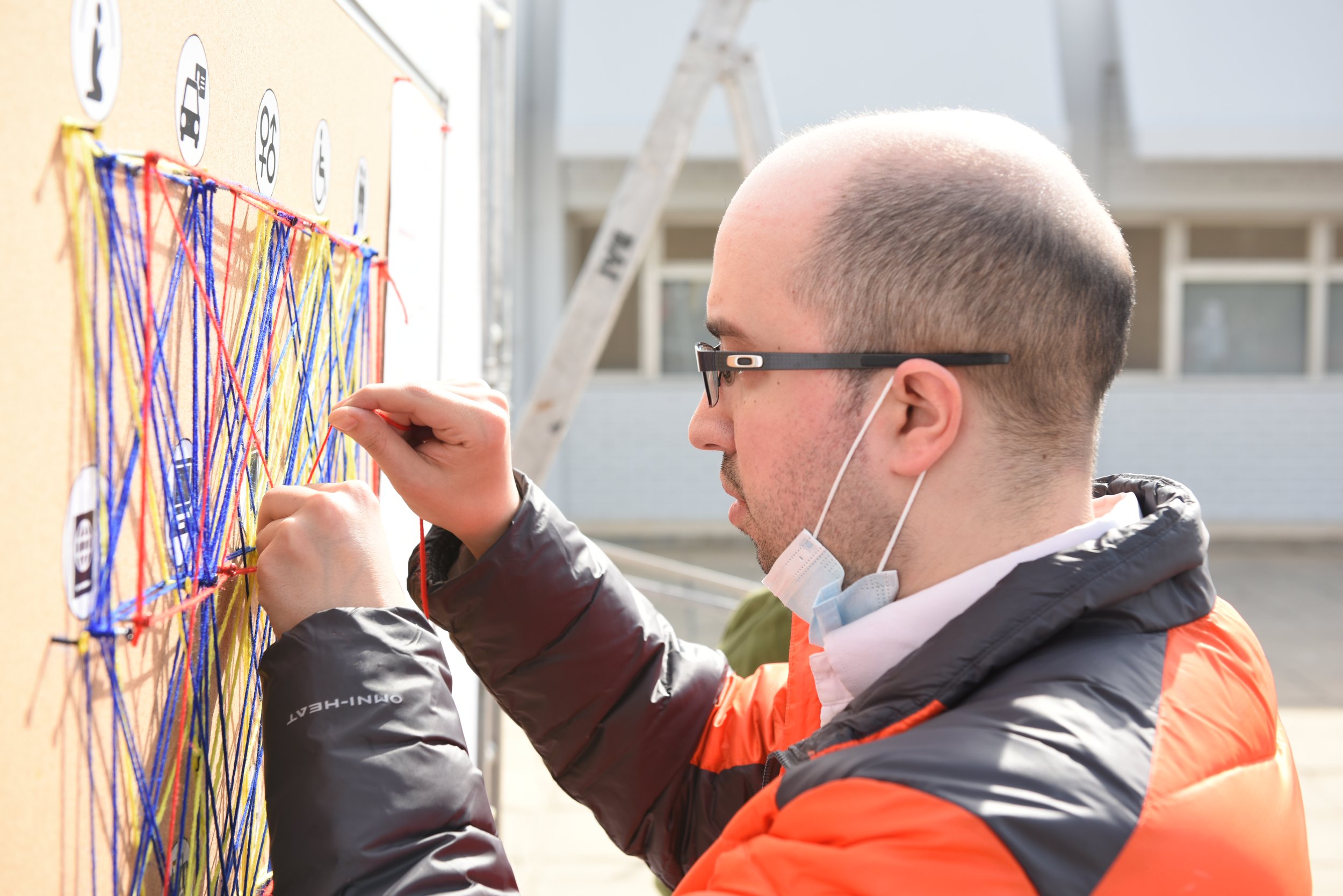
‘Privilege: A Visibility Experience,’ by Vishali Srikanth
Vishali created an interactive data collection and mapping exercise, as a tool to explore our understanding of privilege, and how it is spatialized. She did this to honor her own shift in awareness around the privileges she holds through the program, and to help people understand how broadly privilege can be defined and experienced in Kuwait. She visualized the data she gathered in two different locations across Kuwait (in blue and yellow), and invited attendees to map their own privileges in red during the event.
Exploring Kuwait through an inclusion and equity lens
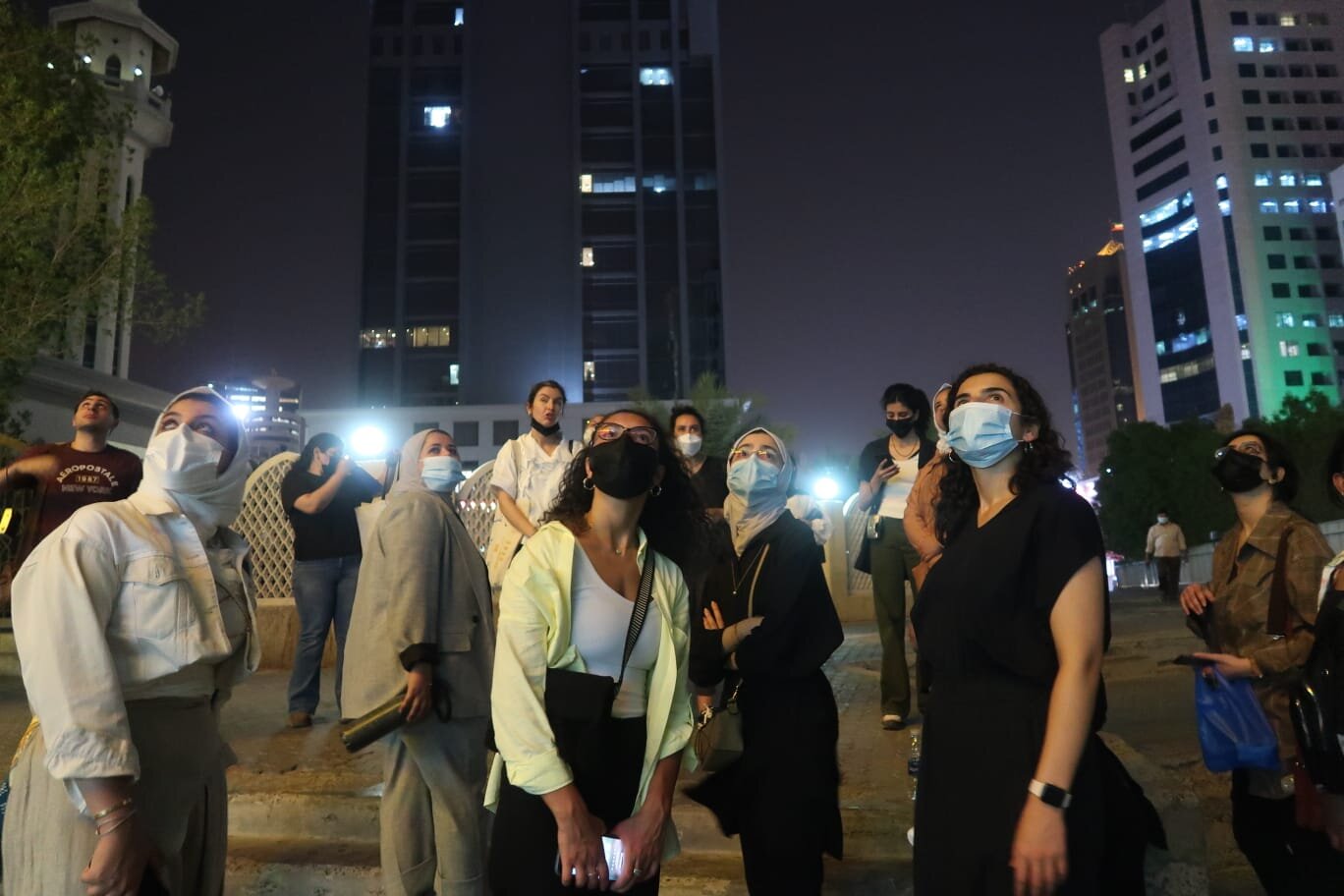
30 Sep 2021 (Kuwait City) – The AWAKEN youth fellowship officially kicked off on August 11th, with a total of 20 participants aged between 18 and 26 from across different universities in Kuwait who represent a wide range of lived experiences and backgrounds as well as an array of disciplines, including Architecture, Visual Communication Design, English Literature and Language, Accounting, Economics, Business, Arts and Graphic Design. Participants meet every week in interactive and immersive sessions facilitated by our amazing team of co-designers, which include Dr. Dalal Alsayer, Deema Alghunaim, Dr. Jawaher Al Bader, Robert Gurney, Dr. Dalal Alfares, Aseel AlYaqoub and Saphiya Abu Al-Maati. Sessions so far have focused on exploring forms of identity and the ways in which they intersect, as well as on deconstructing the privileges and power positions we each occupy, whilst contextualizing it within our exploration of public spaces in Kuwait. We have also been investigating the concept of safety, how it is experienced across participants and different communities, and have combined our online sessions with walking and photography tours across the city.
Curious to learn more? Try for yourself this light exercise we did earlier in the program with our participants, which will help you to start thinking more critically about the spaces you inhabit, and the stories you might hold (you can even do it with a friend or family member).
Exploring space - exercise:
Part I:
Consider a public space in Kuwait (or wherever you are). It can be any place that you think of as public space.
What are its spatial descriptions? What does this space make you feel? Who is in this space? etc.
Draw a map from memory of a public space in Kuwait.
Use any medium (paper, notebook, trace, photograph, paint, pencil, marker, crayon, etc)
Think about the space. What three words would you pick to describe the space?
Part II:
Take your map with you and go to visit your chosen public space. Is it as you described? Is it the same or different? How is it the same or different?
Choose another color pen/pencil (or another medium) and annotate your map based on physically being there.
What is the same as your memory? What is different? What do you notice about the space? Who are the people? What are the objects? What does this space make you feel?
Now think about being in the space. What three words would you pick to describe the space now? Are they the same or different as when you weren’t in the space?
A Twelve-Week Immersive Program for Youth to Collaboratively Reflect on and Reimagine Public Space Towards a More Inclusive Kuwait
In 2021, en.v, in partnership with the International Labour Organization (ILO) and Konrad Adenauer Stiftung (KAS), launched a twelve-week immersive youth fellowship in Kuwait City, bringing together a diverse group of students to collaboratively reflect on and reimagine public space towards a more inclusive Kuwait.
The program, held from August to November 2021, convened designers, architects, artists, researchers, migrant community organizers, and others in weekly sessions centered on dialogue, exploration, and collaboration. Participants engaged in a guided examination of local urban spaces, alongside critical themes such as migration, equity, and belonging—exploring their sociocultural and historical roots, as well as their influence on individual and collective experiences of contemporary community life.
Delivered through online sessions, the fellowship emphasized processes of unlearning, discovery, and practice. Participants worked collaboratively to develop creative projects inspired by the program’s themes, using a wide range of mediums including physical and virtual modeling, printmaking, film, poetry, and storytelling.
The program culminated in a public showcase, where participants presented their work and extended their inquiry into what a more interconnected and inclusive society could look like. Through this experience, participants deepened their understanding of the diverse communities that shape Kuwait’s social fabric, while building the tools, perspectives, and networks needed to collectively reimagine and enhance shared public spaces.
Meet our Facilitators


